Hello juggling community,
As the organizers of EJC 2025, we’d like to address the ticket pricing for the festival. We understand that the increase compared to previous editions might raise questions: Are we mismanaging funds? Are we driving Teslas after the festival? Rest assured, we’d like to explain the multiple factors that influenced our pricing decisions.
Why are ticket prices higher compared to previous EJCs?
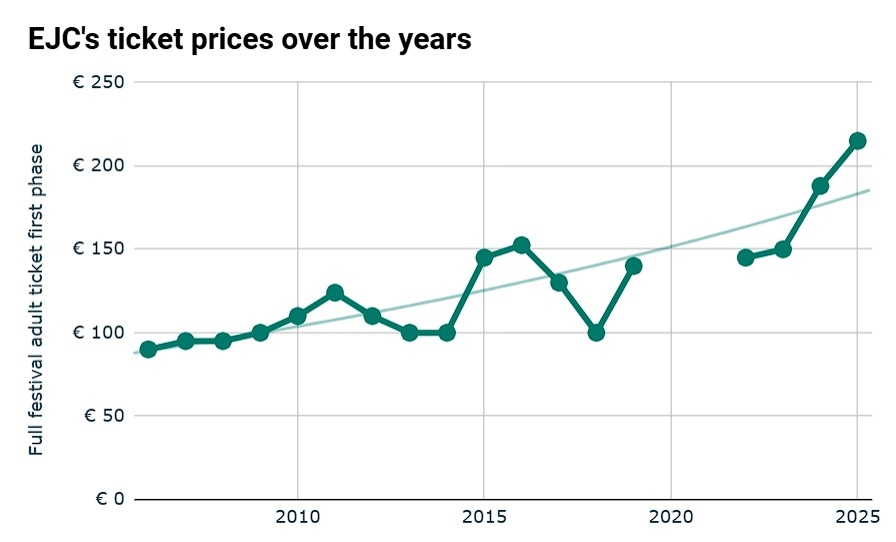
Let’s examine the trends over the last few EJCs. For this, we’ll focus on the most popular ticket—usually the first-phase ticket. For Spain, we considered the second-phase ticket price because the first-phase was limited to 300 people, representing less than 10% of visitors.
Inflation
Inflation is a reality that many of you have experienced firsthand. Prices across the board have risen sharply, especially since 2022. For context, EJC 2016 in Almere charged €127.50 for a full-festival first-phase ticket and €25 for a gala ticket—a total of €152.50. Adjusted for general inflation in the Netherlands, this amount equates to €220 in 2025. Our current prices of €232.50 for a regular ticket (including the gala) and €212.50 for a concession ticket align with these trends.
The Post-COVID industry backlash
The events industry was severely impacted by the COVID-19 pandemic, with many companies forced to recover losses from 2020 and 2021. For instance, event insurance costs in the Netherlands have increased fourfold between 2016 and 2024, significantly outpacing inflation.
Higher costs in Western and Northern Europe
Recent EJCs have been held in countries like Poland, Portugal, and Spain, where labor and materials are relatively affordable. Western and Northern Europe, including the Netherlands, are inherently more expensive. The last comparable EJC was in Newark, UK, in 2019 which makes only now we see the effect of the above two reasons in a more expensive country.
How do we try to make the EJC available for everyone?
Affordable Food and Bar Options
Food is generally more expensive in the Netherlands compared to previous EJC host countries. Since the venue is far from supermarkets and restaurants, we’ve decided to offer essential items without additional margins. While previous EJCs often generated profits from food and drink sales, we’re opting to limit margins on bar and food to keep it accessible.
For context, restaurant beer prices illustrate the disparity:
Concession ticket
We’re reintroducing the concession ticket concept from Lublin 2017 and used also in 2019 Newark. This allows those who need financial support to purchase tickets below cost price, while those who are more fortunate can opt for a support ticket to balance the budget. The approach has shown a near-equal split between support and concession tickets, ensuring fairness for all attendees.
Youth Inclusion
We’ve extended the youth ticket rate (half-price) to individuals aged up to 17, where often the cutoff is 14 or 16 years. This decision aims to attract more young members to the community, fostering growth and continuity. Additionally, we’re organizing a “festival within a festival” for youth circuses, creating a dedicated space for young performers. While this initiative is separately funded, it will share some resources with EJC, serving as a long-term investment in the juggling and circus community.
Funding
We heavily invest in attracting new people in the circus community and making a sustainable impact in the Netherlands. For that, we organise a lot of workshops and shows and generally make the festival attractive for new people before and during the festival. This too costs money, but we leverage cultural funding. This means that we can make opening shows in the city larger given that the city supports us and we can easily make these free for the public and thus benefiting both.
Parking and camper van tickets
To encourage sustainable travel, we’ve introduced fees for parking and camper vans. This approach incentivizes carpooling and helps us budget for the exact space required at the venue. It also ensures that those who choose more eco-friendly transportation aren’t subsidizing parking costs for others.
Paying core organizers
While it may seem counterintuitive, paying core organizers improves the festival’s financial sustainability. In the Netherlands, professionalization in the cultural sector is prioritized, and funding agencies favor organizations that compensate their teams. By paying ourselves minimum wage for one-third of our time, we increase our chances of securing grants, which helps reduce ticket costs. For context, most of our work remains voluntary, and this modest compensation enables us to dedicate time to organizing EJC without jeopardizing our livelihoods.
Final Thoughts
In summary, we’ve explained the factors contributing to higher ticket prices and outlined measures to keep EJC 2025 inclusive. Thank you for taking the time to read this, and we’re happy to answer any questions you may have. Feel free to reach out at simon@ejc2025.org.
We hope to see you in Arnhem in 2025!
Warm regards,
The EJC 2025 Organizing Team
Ticket prices EJC 2006-2025