A Practical Guide for Future EJC Organisers #1
Introduction
The venue is the heartbeat of every European Juggling Convention (EJC). It shapes the experiences of thousands of jugglers: how they meet, where they perform, how they connect with the local culture. But how do you find a venue that can support the rich variety of activities and the sheer scale of an EJC? This guide shares insights from organising EJC 2025 in the Netherlands to help future organisers navigate that journey.
The Search Begins
For EJC 2025, we started with a team first and a venue second. That’s one of the two common starting points—either you fall in love with a location and build a team around it, or you gather your people and begin the hunt. We were the latter. With a small and motivated crew, we began scouting across our flat little country, hoping to strike the balance between infrastructure and inspiration.
Our requirements were clear in theory but tricky in practice. We needed a place to juggle (large, safe indoor spaces), a place to sleep (camping for thousands), and a space to gather (the festival village). Ideally, everything had to be close together and walkable.
How Much Hall space Are We Talking?
The number of participants has always varied, but some patterns emerged. EJCs in central Europe, like Almere or Karlsruhe, typically attract over 5,000 jugglers. Peripheral ones, like Joensuu or the Azores, tend to be smaller. We estimated around 5,000 attendees and aimed to accommodate up to 7,000.
We leaned on a helpful (but somewhat mysterious) EJA guideline: 3m² per juggler, assuming only 40% are juggling at a time. That gives us about 1.2m² per person, and with 5,000 people, we were looking at 6,000m² of indoor juggling space.
Looking at past EJCs helped. Almere felt cramped with just 0.68m² per person. Lublin had over 3m² per juggler and still felt spacious. Weather also matters: in Toulouse, high temperatures and non-airconditioned halls meant fewer people juggled inside. We tried to account for these nuances with crowding scores and climate estimates.
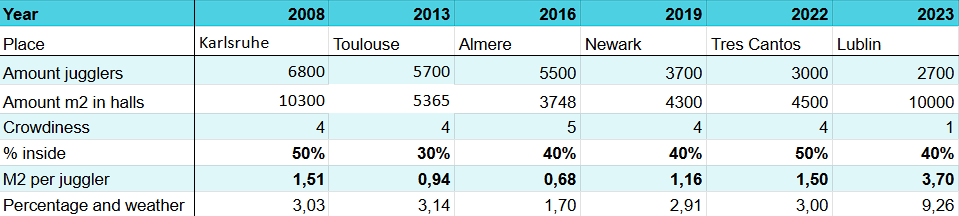
From this we can conclude that the estimate of the EJA is spot on also in our case, where we need 3m2 for 40% of the time (average climate) which gives us 1,2m2 per juggler. With 5000 jugglers that means at least around 6000m2 of hall area.
How Much Grass is Enough?
Camping is another critical factor, and not just the tents. The grassy area also hosts show tents, food trucks, seating areas, and casual gathering spaces—the beloved “festival village.”
While some festivals manage to pack 10,000 people into 50,000m², those are short music events. An EJC lasts eight days. People bring juggling gear, families, shade structures. Ten square meters per person feels right.
We checked past EJCs, looked at satellite photos, remembered the feeling of walking through tent fields. Our conclusion: aim for at least 50,000m² of camping area and another 20,000m² for the village. That brings the total to about 70,000m² of usable flat land.
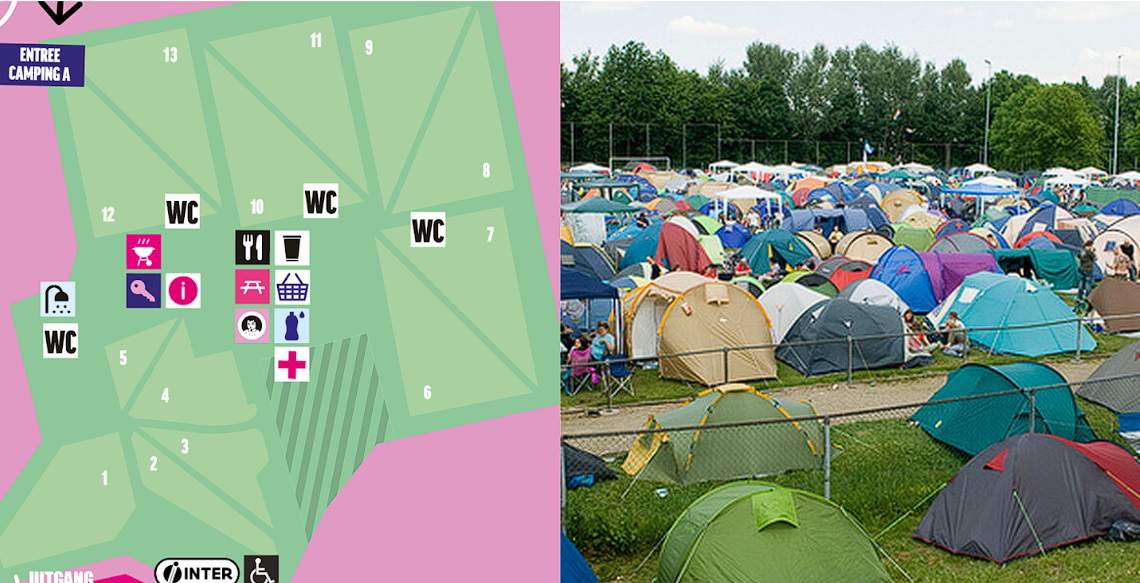
The above music festival hosts 10.000 people on 50.000 m2. Which is around 5m2 per person. These campings are however literally packed, each spot is filled even on small hills, or literally stone, even people have put tents in the middle of mini group tents. This isn’t desired for camping for 8-days with all your juggling gear. However it gives a good scenario of the literal minimum you need per person in the worst case scenario.
Looking back at previous EJC - we see around 10m2 per juggler of camping. We took into account how packed the camping was from either air pictures, video’s or personal experience.
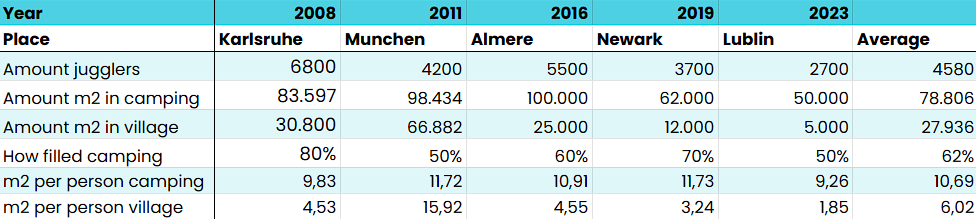
The festival village varies in size depending on the set up of how many activities take place in tents or halls. E.g. Lublin was so small since all shows were in nearby halls. Also Newark had multiple activities inside like unicycling and axe throwing that could be outside. If we ignore the outliers, you come to 4m2 needed for the festival village.
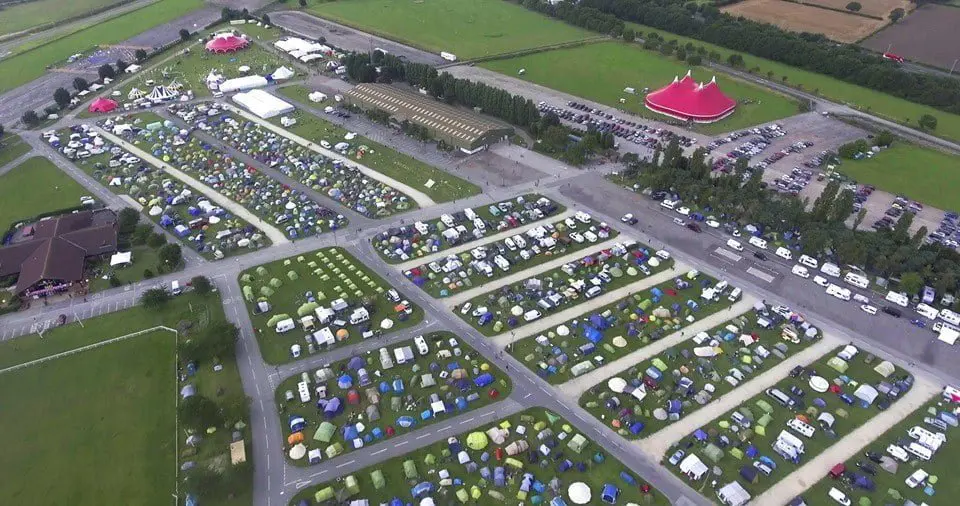
Newark with 3700 participants - a 62.000m2 camping that we consider 70% filled
Therefore for 5000 jugglers we would need camping of 50.0000 m2 and festival village for 20.000 m2 and thus we are looking for a combined area of 70.000m2 of flat surface or grass.
Shortlisting Venues
With numbers in mind, we started our search. We looked up the largest sports halls in the Netherlands. We combed through older EJC evaluations. We asked jugglers at Dutch conventions for hidden gems near their hometowns.
That gave us a list of 25 potential locations. We evaluated them for juggling space, camping surface, and general feasibility. Event centres were attractive, but urban areas often made camping difficult. Ice skating rinks were spacious, but not always well located.
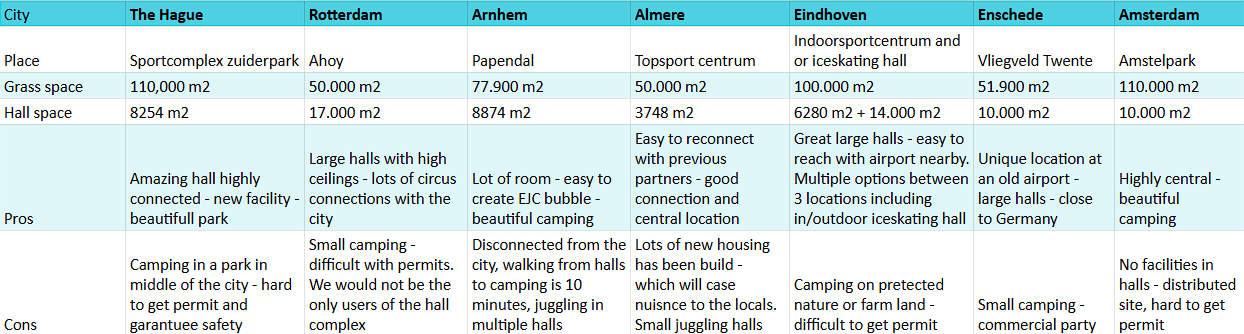
Each had unique strengths and serious caveats. The Hague’s park was beautiful but tough to get permits for. Eindhoven’s halls were great, but camping was near protected land. Enschede had space, but little support infrastructure. Rotterdam had high ceilings but limited surrounding space. Arnhem emerged as a strong contender with its mix of space, support, and municipal enthusiasm.
The Site Visits
Visiting each location changed a lot in terms of how well we thought they would fit as an EJC location. A site on paper is one thing. Some places that looked perfect online quickly fell apart due to noise concerns, local restrictions, or fragmented layouts.
Arnhem, with its Papendal sports complex, made it to our top three alongside The Hague and Eindhoven. Papendal had everything within reach and, importantly, a location that was on board from day one. That mattered more than anything else. The ability to get permits without endless red tape made Arnhem the obvious choice in the end.
Reality vs. Ideal
You could have a lot of secondary requirements, but often you don’t have the luxury to consider these due to the limitations that already the municipality and site costs put in your options. From an organiser perspective, important secondary options are reachability, closeness to city, local support, funding possibilities. For participants they have shared in EJA surveys that great halls are the most important, a compact site and closeness to shops (supermarket). In our case, secondary conditions weren’t a great match, but solvable e.g with an on site supermarket and pendelbusses to the city.
Preparing Your Bid
With Arnhem chosen, we focused on preparing our bid for the EJA General Assembly. While it was tempting to present multiple venue options, we found it clearer to go all in on a single, strong proposal. We made sure to:
- Finalise our decision two months before the GA
- Get written support from the municipality
- Gather maps, photos, and cost estimates
A clear, confident bid shows jugglers and city officials alike that you’re serious—and that your team is already aligned.
Key Takeaways
- Start early and visit potential sites in person
- Aim for 1.2 m² of juggling space per person
- Plan 10 m² of camping space per juggler
- Don’t forget 4 m² per person for festival village
- Consider reachability, permits, and municipality support
- Pick one site for your bid and secure early buy-in
Final Thoughts
Finding the right venue is half the challenge of organising an EJC. We hope these lessons and numbers give you a solid foundation to build from. Each country and city will offer different challenges, but a good process, clear requirements, and community input will go a long way.
Good luck, and see you at the next EJC!